Mapping Revenue-Critical User Flows: Driving Growth Through UX Insight
Critical user journeys are a key component when designing an engaging platform, without mapping the journey for your users they will get lost, reach a road block, and eventually give up. Follow this guide to learn about this importance of critical user journeys and how to make one.
If your user base is not growing more than a certain point, you need to understand the critical paths which users take in your product. Some of the biggest companies, like Google, use critical user journeys to find new opportunities for driving revenue, retention, and even satisfaction.
Studies show that 40% of potential customers will leave a site if it takes more than three seconds to load,
Thus, critical user journeys help product teams visualize the most important interactions, discover friction areas, and focus their design and development efforts where the most impact is achieved. In contrast to broad user experience maps, these journeys zoom in on specific flows that determine business success.
Optimizing these pathways will help the team reduce user churn, increase customer loyalty, and grow revenue without introducing unneeded complexity elsewhere in the product.
What Do Critical User Journeys Mean?
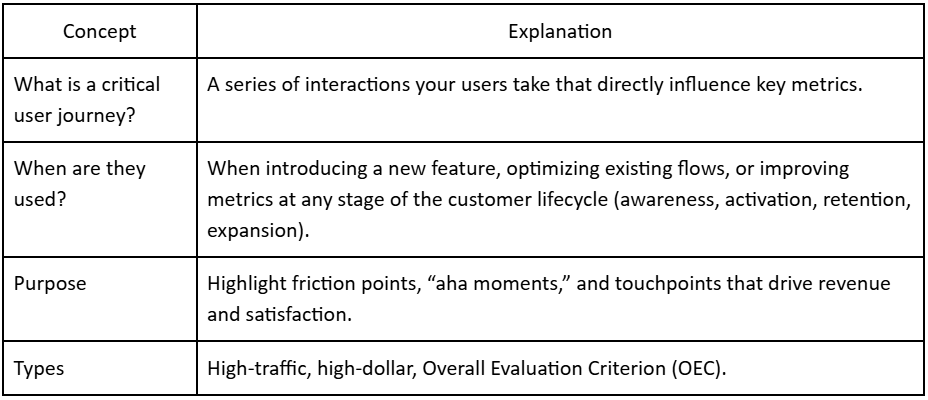
Critical user journeys are clearly defined interactions a user takes within a product. These journeys are important for business success, helping boost revenue, increase retention, and improve engagement. They are more specific than broad user experience journeys.
They are useful when releasing new features, revisiting flows, or aligning cross-functional teams. Critical user journeys help isolate actions that have the most impact, identify friction points, and improve usability while supporting business goals.
They are also practical. Mapping these journeys shows where to optimize flows to improve efficiency, increase adoption, and reduce churn. This helps teams make data-informed decisions and focus on high-impact interactions.
Key components include
What it is: A measurable sequence of interactions tied to business goals. When to use it: During feature launches or lifecycle stages like acquisition and retention. Purpose: Identify value realization points and opportunities. Types: High-traffic, high-dollar, and OEC journeys.
These journeys are particularly valuable when launching new features, iterating on existing flows, or aligning teams on what matters most to the business.
Why Critical User Journeys Matter
Critical user journeys serve multiple business and design goals:
Improving user experience – Identifying friction allows focused solutions.
Boosting satisfaction and revenue – Smoother experiences retain users and increase spending.
Driving company alignment – Visualizing journeys helps teams prioritize consistently across product, marketing, and customer success.
The financial stakes are massive. Baymard’s research shows the average large e-commerce site can increase its conversion rate by 35.26% simply by optimizing the checkout journey. For businesses in the U.S. and EU, this represents over $260 billion in recoverable revenue lost to avoidable friction.
(Insert internal link to related article here – The “Jobs To Be Done” UI Audit: Designing for the User’s Real Goal)
To better understand user goals and pain points within these journeys, see our Jobs To Be Done UI Audit guide, which focuses on designing around the interactions that truly drive value.
Types of Critical User Journeys
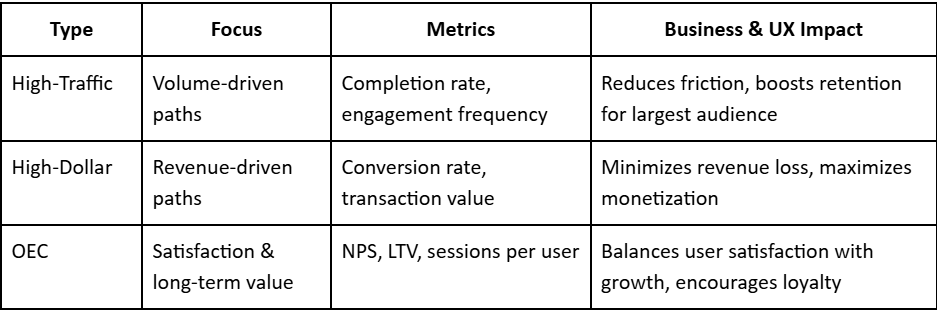
To prioritize optimization, categorize journeys into three high-impact types:
High-Traffic: These are the most-used paths, such as onboarding or search. Optimizing here impacts the largest audience, improving completion rates and driving early retention.
High-Dollar: These directly generate revenue, like checkout or subscription upgrades. With 17% of shoppers abandoning for process complexity, refining these flows maximizes conversion and minimizes revenue risk.
Overall Evaluation Criterion (OEC): These focus on long-term value and satisfaction metrics like NPS or Lifetime Value (LTV). Balancing user delight with business growth ensures repeat engagement.
Each type matters differently: high-traffic impacts adoption, high-dollar impacts revenue, and OEC impacts long-term retention. By mapping and optimizing each journey, teams can focus on what truly drives product success.
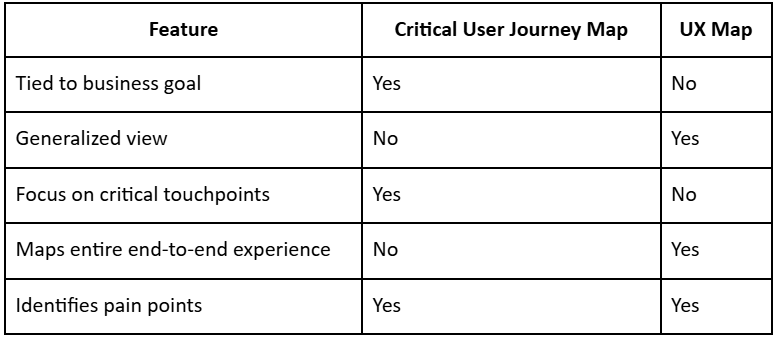
Critical User Journeys vs User Experience Maps
While both visualize user behavior, there are clear differences:
Takeaway: Critical journeys are narrow, goal-focused, and designed to improve revenue and satisfaction.
How to Create Critical User Journey Maps
Creating a critical user journey map is a structured process that helps teams visualize the interactions users take to achieve specific goals and identify friction points that impact both user satisfaction and business outcomes. The process can be broken down into five actionable steps.
1. Get Stakeholder Buy-In
Before mapping begins, engage key stakeholders across product, design, marketing, sales, and customer success. Explain the purpose of mapping, the expected outcomes, and how it will align teams. Stakeholder buy-in ensures resources are allocated and encourages cross-functional collaboration.
2. Select the Journey Stage
Critical user journeys should focus on high-impact stages within the customer lifecycle, acquisition, activation, retention, or expansion. For instance, a SaaS product might map the journey from trial sign-up to first successful feature use, while an e-commerce platform may focus on the checkout process. Ask: Which stage affects revenue, retention, or engagement most?
3. Narrow the Scope
Rather than mapping an entire end-to-end experience, limit the scope to a manageable set of touchpoints, usually 3–5 critical steps. This keeps the analysis focused and actionable. For example, a “Primary flow” for onboarding might include account creation, initial setup, and completing the first task.
4. Identify the “Primary flow” and Friction Points
Use quantitative research methods to define the ideal path:
Funnel analysis highlights drop-offs along predefined steps.
Path analysis discovers common user deviations from the expected route.
Surveys measure satisfaction (CSAT), effort (CES), and loyalty (NPS) at each stage. These methods reveal both pain points and moments of value realization in the journey.
5. Map the Journey
Visualize the journey using tools like Miro, Figma, or Lucidchart. Plot key actions, decision points, and touchpoints. Overlay quantitative metrics (drop-offs, completion rates, CSAT scores) and qualitative insights to contextualize user behavior. Best practices include:
Keep the map clear and easy to read.
Highlight friction points and opportunities for improvement.
Incorporate stakeholder feedback for validation.
By following these steps, teams can create actionable, data-informed critical user journey maps that guide design decisions, reduce friction, and maximize business and UX impact. These maps serve as both a diagnostic tool and a strategic roadmap for improving adoption, retention, and revenue.
Conclusion
Critical user journey mapping is more than a design exercise; it is a strategic tool for aligning teams, improving customer experience, and driving revenue.
By focusing on high-traffic, high-dollar, and OEC flows, organizations can uncover friction, optimize user satisfaction, and make informed product decisions.
The payoff is clear: better adoption, higher retention, and measurable business growth.
Start mapping today to understand the journeys that matter most and ensure every interaction contributes to both user delight and your bottom line.
More to Explore
research
How UX Debt Accumulates in Healthcare Products
research
Designing for Health Literacy: A UX Framework
research
Does Your Product Need a Consultant or an In-House Designer Right Now?