How to Identify UX Debt Before It Becomes a Product Problem
The devil is in the details and as small inconsistencies, extra steps, and features grow be on the lookout for those details that compromise the users experience to limit UX debt.
Most products don’t fail instantly, but instead, become more difficult to use over time. It starts with smaller problems, such as an extra step in a process, a strange page, or a feature not functioning as seamlessly as others. Issues like these may seem small, but they accumulate as UX debt while teams are focused on other priorities.
Studies show UX debt often stems from code, architecture, and process decisions, but its real impact is felt in degraded user experience and productivity.
This phenomenon is not only a concern for designers but the entire business as a whole. UX debt over time manifests as a product limitation. Development becomes stagnant, users stop converting, and as a result, business performance drops significantly. Before we get into the details you should understand what is UX debt?
The term “UX debt” refers to the accumulated inconsistencies, usability, and design gaps that reduce the experience as a whole. This results from prioritizing other aspects of the system.
Why UX Debt Doesn’t Feel Like a Problem at First
It doesn’t feel like a problem because teams focus on speed and short-term results. These shortcuts help teams move faster early on, even if they are not ideal long term. Extra steps in flows or reused layouts may not be perfect, but they serve immediate goals.
Why Are Early UX Shortcuts Considered Okay?
With an MVP (Minimum Viable Product) mindset, progress is prioritized over refining the user experience. UX flaws are seen as temporary and fixable later. However, these decisions are rarely tracked as temporary. Over time, they become part of the product’s foundation. Interactions diverge, components behave inconsistently, and the overall UX becomes fragmented.
When Do Temporary Solutions Become a Real Risk?
The shift is gradual. As temporary fixes accumulate, replacing them becomes harder. Teams avoid revisiting them, and inconsistencies grow. Internally, familiarity hides the issue. Externally, users feel the friction immediately, leading to a slower, less efficient product.
How To Identify UX Debt in Your Product
The debt shows up in areas that the team deems “normal,” and will eventually encompass every interaction and feature that becomes less usable. Catching it early is critical to staving off larger problems.
Inconsistency Across Flows
Actions that should behave the same often don’t. A button might save data in one flow but trigger a confirmation in another. A swipe could archive content on one screen but delete it on another. Minor variations confuse users, slow tasks, and increase maintenance work. Fragmented design patterns, like mismatched colors, typography, or spacing, make the interface feel patched together.
Increased Effort for Simple Tasks
Basic actions may require extra clicks, thinking, or unexpected steps. Users must remember the differences between screens, interpret unclear labels, or work around confusing interactions. High cognitive load signals accumulated UX debt and frustrates users over time.
Hidden Impact on Performance
UX debt affects business metrics. Drop-offs in onboarding, abandoned checkouts, or stalled workflows often trace back to inconsistent design. Small usability issues ripple through the user journey, reducing conversion, retention, and growth. Prioritizing high-impact flows ensures UX debt doesn’t silently undermine business outcomes.
(Insert internal link to related article here – The 'Problem-First' Prototype: Designing to Test Hypotheses, Not Features)
(To see how early validation can prevent UX debt, read our blog on The 'Problem-First' Prototype: Designing to Test Hypotheses, Not Features.)
Why UX Debt Is Hard to Notice Internally
UX debt grows quietly because teams experience the product differently from users. What feels natural internally can feel confusing to first-time users. Familiarity creates blind spots, making inconsistencies easy to miss.
Teams adapt faster than users
Teams build muscle memory for flows, shortcuts, and logic that users don’t have.
Examples Support staff rely on shortcuts, while users struggle to complete tasks. Designers understand labels, but users misinterpret them.
Metrics don’t show everything
Surface metrics like clicks or conversions may look fine, but deeper friction exists.
Shipping new features can mask underlying problems and increase inconsistency.
Examples New filters add confusion to cluttered pages. Dashboards grow complex without improving clarity.
UX debt becomes visible only when teams observe real user behavior and test flows regularly.
Where UX Debt Comes From
UX debt builds through everyday design and development decisions, often driven by speed. Identifying its sources helps prevent small compromises from becoming larger usability issues.
Rushed Releases and Sprint Pressure
Speed often comes at the cost of experience quality. Skipping usability checks or leaving temporary fixes in place creates friction over time. This is reflected in industry data: over 76% of software professionalsreport seeing "code-centric" debt, which occurs when technical implementation shortcuts (such as messy CSS or inconsistent component reuse) directly undermine the user interface.
Weak or Inconsistent Design Systems
Fragmented design systems lead to inconsistent UI components and interaction patterns. For example, a primary CTA may look or behave differently across screens, increasing cognitive load.
Poor Prioritization of UX Work
UX improvements are often deprioritized. Issues in navigation, forms, or accessibility build up, increasing complexity for users and teams.
Lack of Ownership
Without clear ownership, consistency breaks down. Components and interactions drift, reducing usability and trust over time.
How to Spot UX Debt Early
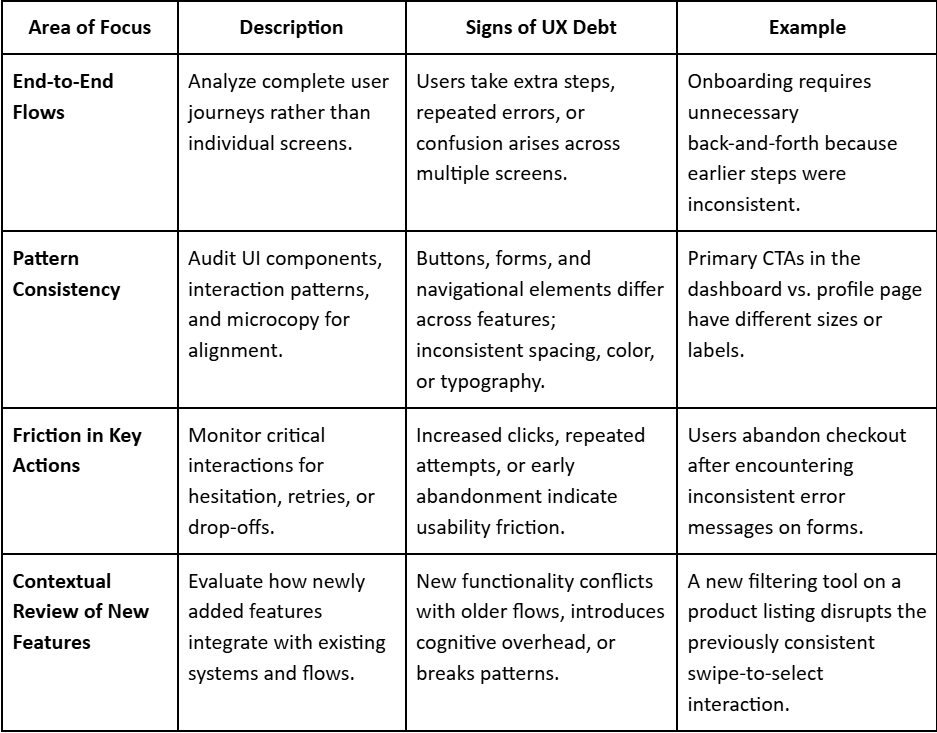
The table below shows you practical areas to focus on, common signs of debt, and examples to guide your audits.
How To Manage UX Debt Without Slowing Down
Managing UX debt doesn’t mean slowing development. Prioritize high-impact flows like onboarding or checkout. Most teams report process and code-related UX issues, so fix inconsistencies during feature work. Track debt through audits and tie improvements to metrics such as drop-offs and task completion.
Preventing UX Debt Before It Builds
Prevention starts with alignment. Product, design, and engineering teams must share a clear understanding of trade-offs to avoid conflicting decisions. Design systems should be treated as infrastructure, ensuring consistency across components and interactions.
Embedding UX reviews into each sprint helps catch friction early and prevents issues from spreading.
Why UX Debt Management is Essential
UX debt is inevitable, but unmanaged debt slows development and impacts usability. Small compromises compound over time. With consistent audits and alignment, teams can maintain speed while keeping the product scalable and user-friendly.
More to Explore
research
How UX Debt Accumulates in Healthcare Products
research
Designing for Health Literacy: A UX Framework
research
Does Your Product Need a Consultant or an In-House Designer Right Now?